Tuesday, July 13, 2010
Reading Leo Marx
Sunday, July 11, 2010
700 million, 26 Billion
How many people watched the World Cup final today? FIFA estimates more than 700 million. According to Graham Dunbar of the AP in Johannesburg, it will most likely break the record for a sporting event in Spain and the Netherlands. An estimated cumulative audience of 26 billion viewers watched the 64 matches at the 2006 tournament, but FIFA is calculating the current tournament by overnight market share reports where possible.
Friday, July 9, 2010
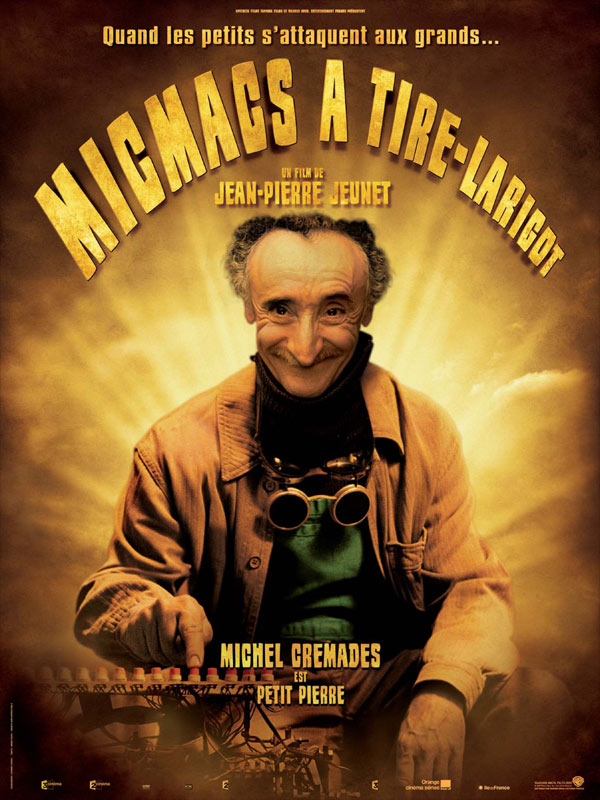
Micmacs à tire-larigot

I went to the film Micmacs à tire-larigot tonight; it was the last big screenshowing in Santa Cruz, and I'd hear that it was both a great anarchist film and a film that had lots of technology in it. The theatre was reasonably full - a good sign for a foreign film - and the strong coffee I drank right before the showing helped put me in the mood for the frenetic opening sequence.

Thursday, July 8, 2010
Mundane Cyborg five: technological sublime and the pastoral/Arcadian
I'm looking at a few pieces of a puzzle for my cyborg book. One piece is the way we have traditionally viewed the cybernetic and the organic, the machinic and the “natural.”
In “Re-viewing Nature; Machines and Industry; Greek Revival Architecture,” Tuomi J. Forrest argues that early Americans saw both the wilderness and the city as profane and dangerous. Reading Leo Marx among other theorists, she documents the shift from Nature as “howling wilderness” to Nature as viewed by Romanticism. The natural world still evoked fear, but this fear was folded into a larger view of Nature as a sublime source of spiritual renewal. (Forrest’s piece is on the web and lovingly illustrated, and includes a terrific Bierstadt piece that evokes this American romanticism perfectly). In time, for both Americans and for Europeans like Wordsworth, technologies like the steam engine and railroad would come to vie with Nature as a source of the sublime in life. And the tension between romantic and utilitarian views of the natural world also held sway in the design of powerful new technologies like Philadelphia’s Fairmount Water Works (which the article uses as a model of technologies which merged desire for power with desire for beauty in a ‘third way” of Greek Revival architecture. Forrest writes,
Perhaps in response to human fears about the power unleashed by the steam engine and other new marvels, some manufactures sought to 'disguise' their new machines with painted and molded leaves, vines, and flowers, or with architectural motifs. This practice visually linked technology to the natural world, and with the trends such as Greek Revival architecture. And as the historian Roger Kennedy claims, the new Greek buildings occupy the desired pastoral 'middle state' "between corruption (Europe) and savagery (the West)."
The article raises a number of issues, including the way practical Americans like Franklin argued that the beautiful for democratic peoples had to be utilitarian, not ornamental as it was for the wealthy in Europe:
In the early republic, many sought to balance the value of 'usefulness' versus that of 'beauty'. As de Tocqueville noted: "democratic peoples. . .cultivate those arts which help make life comfortable rather than those which adorn it. They habitually put use before beauty, and they want beauty itself to be useful." He seems to be echoing that most practical of Philadelphians, Benjamin Franklin, who claimed "nothing is good or beautiful but in the measure that it is useful." However, as John Kasson has observed, "yet the converse was true as well: American wanted the useful to be beautiful."(142)
There is something in the cyborg that calls to us from this matrix of history, ideology, and material practice. The cyborg motions to the inner landscape as the Romantics did, and suggests that at the moment that (inner human) “nature” is being threatened by urbanization and by technology, a powerful desire for the sublime moves us toward a redefined and exalted human (the Romantics imagined we could find transcendent meaning and power in our relation to the natural world) and toward a connection with newer sublimes (from God to Nature to railroads and telegraphs and new stories of the cosmos and the microscopic).
And for Kevin’s work (Kevin Bell that is, my friend and co-conspirator), the image of a Water Works from the early 19th Century that promises a merging of utility and beauty via Greek revival architecture, and which delivers it, but also delivers massive pollution from the mills that use this power will most likely provide him with a precursor to the transformation of the Columbia River, that “organic machine,” a transformation paved with good intentions. Here is Forrest on the outcome of this merging of power and beauty in the form of technological advancement:
The problem with this approach--the exploitation of natural resources to the detriment of the public--is another side of the Water Works' story. The system, at least for a period, was able to tenuously balance public and private needs; a public park, and public water supply benefited the entire city. The site's uniqueness and fame proved a boon to hoteliers and restaurateurs, and the dam that funneled water into the wheel houses also allowed for the passage of barges. However, the same mills that Coxe advocated ultimately destroyed the water quality of the Schuylkill. And through the mid 1800's the city bought plots of land upstream from the works in an attempt to rid the banks of the Schuylkill and the Wissahickon of the many polluting factories.
Hundreds came to marvel at the huge “gears and wheels, moving efficiently, noiselessly, and powerfully.” Yet these powerful gears were housed in a Greek temple, and Forrest argues that the entire Water Works was an attempt to merge the natural and the human in order to produce Leo Marx’s pastoral ideal.
I think this notion of utility of nature is itself corrosive of most attempts to make technological advances pastoral. This indeed is what most of the Romantics thought as well (Shelley, especially, but also Thoreau and Emerson), and it informs Heidegger’s famous essay on technology and the view of the world as simply raw material.
But I am also fascinated by our desire for power and for beauty, and the early attempt to link this utility of technology to categories of the beautiful and the pastoral, and to democratic roots of Greek revival as opposed to Roman Imperial England fascinates me.
And I’m using a slightly different terminology to address this: I’m interested not so much in the pastoral but in versions of the Arcadian. I’ll elaborate later, when it is not 1:30 am!
The entire essay by Tuomi Forrest can be found at:
http://xroads.virginia.edu/~ma96/forrest/ww/home.html
Tuesday, July 6, 2010
Mundane Cyborg four: the meaning of mundane
Well it seems time to consider the meaning of mundane in mundane cyborg.
1
I originally meant mundane to contrast with the more technologically sublime versions of cyborgs: individual human/machine cyborgs, “put together” by huge efforts of doctors, bioengineers, surgeons, and so on. RoboCop is a body that has been all but killed, and reviving that body takes enormous resources, whih only a huge corporation or the government would have available. In the anime series Mobile Suit Gundam, individual humans pilot huge military exoskeletons, merging their intincts and bodily reflexes with the movements of three story building high metal bodies that fly, fire missiles, and so on. In the TV show the Six Million Dollar Man, the cyborg costs…well, $6 million! And that was a lot back in 1974 (or actually, 1972, when Martin Caidin wrote his original Cyborg novel and set the price of a machine man at six big ones).
So in a way writing about the mundane cyborg forces me to consider how to talk about these other cyborgs: the not mundane or not quotidian uses of these technologies, for example. The extraordinary, as opposed to ordinary, cyborg. I think Leo Marx’s use of the technological sublime in his book The Machine in the Garden captures part of what I am after here: according to Britannica, the term “indicate[s] a quasi-spiritual haze given off by any particularly visible and impressive technological advance. Science fiction dotes on the sublime, which ruptures the everyday and lifts the human spirit to the plateaus of high imagination. Common models of the technological sublime include railroads, photography, aviation, giant dams, rural electrification (a particular Soviet favourite), atomic power and atomic weapons, space flight, television, computers, virtual reality, and the “information superhighway.”
The irony of mundane cyborg is that mundane works against cyborg; that is, the cyborg is clearly wildly nonnatural, dangerous, a sign of the posthuman, and so on. You get the sense of the end of the human and the natural and the beginning of some very other world. But this latter telos or aim of cyborg technologies is, I argue, just as likely to come from the ubiquitous small technologies that we merge with every day: our smart phones and iPods and GPS devices and scanners and so on.
2
So what does mundane mean? The etymology of the word (found at etymonline.com) has to do with world or worldy:
late 15c., from M.Fr. mondain (12c.), from L. mundanus "belonging to the world" (as distinct from the Church), from mundus "universe, world," lit. "clean, elegant"; used as a transl. of Gk. khosmos (see cosmos) in its Pythagorean sense of "the physical universe" (the original sense of the Gk. word was "orderly arrangement"). L. mundus also was used of a woman's "ornaments, dress," and is related to the adj. mundus "clean, elegant" (used of women's dress, etc.)
If mondain refers to belonging to the world, then its opposite would be belonging to the Church, or to the not-this-world, to the otherworldly (which certainly applies to Terminator, and in a way to the sense that this technology is creating an/other world). And if cyborgs usually create disorder in various ways (category disorders, war and conflicts, crises between the augmented and the nonaugmented), then the mundane cyborgs would be the organic-machine hybrids that are restored to an orderly arrangement. So the newly functional prosthetic arm of an amputee from Iraq may be seen as mundane, insofar as it restores what was originally there in the world.
I found another interesting definition of mundane on Charles Hodgson’s delightful online site Podictionary. He recapitulates most dictionary definitions when he writes that “ mundane means “of the world” and when I hear people talk about things that are mundane they usually mean things that are average, undistinguished, pretty regular every day things.” But then he mentions other nontypical meanings:
- To officials of the Church, people who were mundane were “of the world” and so, non-officials of the church.
- Charles Darwin said that owls were mundane, and by that he meant they were ubiquitous, “of the world” they exist pretty much everywhere.
- Those with a broad perspective of how our planet fits into the universe used “mundane” as a synonym for “cosmic.”
- And finally, mundane has been used with the same winking acknowledgement as the phrase “man of the world” with a meaning that a mundane person was one who enjoyed their earthly pleasures.
But then he references urbandictionary, and as he slyly puts it, “entered a whole other monde.” In RPGs (role playing games), you have your online persona (mine back in the ‘90s was cybunny, before this became a real persona in the the 1999 Neopian world of Neopets) and then you have your actual name outside of the game. This identify is called your “mundane.” Hodgson points out that the definition of mundane from OED as people who are not hard core sci fi fans has been around since the late 1950s.
3
This leads me to the Mundane Science Fiction movement, which appeared in the 2007 edition of Interzone magazine. I listened to an interview with novelist Geoff Ryman on the blogspot http://mundane-sf.blogspot.com/ and read around on the blogspot, and decided to just spam in the basic description from Wikipedia and a couple other sites:
Mundane Science Fiction is a sub-genre of science fiction. Inspired by an idea of Julian Todd, the Mundane SF movement was founded in 2002 during the Clarion workshop by novelist Geoff Ryman among others. It focuses on stories set on or near the Earth, with a believable use of technology and science as it exists at the time the story is written.
The central ideas are:
- That interstellar travel remains unlikely; that warp drives, worm holes, and other forms of faster-than-light travel are wish fulfillment fantasies rather than serious speculation about a possible future.
- That unfounded speculation about interstellar travel can lead to an illusion of a universe abundant with worlds as hospitable to life as this Earth. This is also viewed as unlikely.
- That this dream of abundance can encourage a wasteful attitude to the abundance that is here on Earth.
- That there is no evidence whatsoever of intelligences elsewhere in the universe. That absence of evidence is not evidence of absence -- however, it is considered unlikely that alien intelligences will overcome the physical constraints on interstellar travel any better than we can.
- That interstellar trade (and colonization, war, federations, etc.) is therefore highly unlikely.
- That communication with alien intelligences over such vast distances will be vexed by: the enormous time lag in exchange of messages and the likelihood of enormous and probably currently unimaginable differences between us and aliens.
- That there is no present evidence whatsoever that quantum uncertainty has any effect at the macro level and that therefore it is highly unlikely that there are whole alternative universes to be visited.
- That therefore our most likely future is on this planet and within this solar system, and that it is highly unlikely that intelligent life survives elsewhere in this solar system. Any contact with aliens is likely to be tenuous, and unprofitable.
- That the most likely future is one in which we only have ourselves and this planet.
Geoff Ryman has contrasted mundane science fiction with regular science fiction through the desire of teenagers to leave their parents' homes. Ryman sees too much of regular science fiction being based on an "adolescent desire to run away from our world." However, Ryman notes that humans are not truly considered grown-up until they "create a new home of their own," which is what mundane science fiction aims to do.
I think this latter sense of “creating a new home” is what I would like to do as well; that is, take a look at fictions and nonfictions that try to imagine us shaping these mundane but powerful technologies, as they inevitably and invariably shape us. (And no I am not unaware that the companies that create these technologies do so with certain shapings in mind; I’m just as clear that ubiquitous computing and SMSing are changing patterns of living and communication in ways the designers of these technologies could not have predicted).
4
So the worldly cyborg is also a product of worldly processes (the greed of corporations hungry for consumers, for example, and the cynical realism of those in political power who are happy to provide virtual bread and circuses for the masses while they undermine most of the best parts of American democratic institutions and round up the usual suspects who protest the undermining). And these cyborgs look mundane; usually there is no monstrous bit poking out (though behaviors can become monstrous, as when an entire class is texting while the professor gazes out helplessly…or is this simply the electronification of students who have always been distracted from the drone of knowledge?).
Any feedback on this idea of the mundane greatly appreciated!
Monday, July 5, 2010
Mundane Cyborg 3: Skyhooks and Cranes, Networks and End Users
1.
Full disclosure: I’m writing this surrounded by a menagerie of machines. This lamp, for example, has that old school lampshade that diffuses light so that I can read the five books surrounding my laptop and so that Margann (my wife squinting over a big colorful puzzle looking for pieces – more or less what I’m about, if I think about it) can have that puzzling satisfaction of putting pieces together, feeling with the hands the tiny sound of a piece snapping into its perfectly designed place.
The lamp is pretty mundane, but lamps arguably changed the way people all over the world live, and certainly whales know the cruel realities of humans addicted to their lamp oil.
The circle of light cast by the light shines on the laptop (the aluminum brick MacBook with its lamp-backlit keys), the cell phone (LG NV Touch, with its kind-of-smart phone features and virtual keyboard), the camera (a Canon PowerShot with its animal-snout lens and three cyborg eyes), the SanDisk micro card reader, the two sets of headphones (one healthy, the other deaf in one ear). And signs of other mundane and ubiquitous technologies: AA batteries (for the iPod portable speakers), keys (for Kevin’s Audi, for my Honda Civic hybrid, for Claire’s old school Honda with the stick). And two sets of eyeglasses (wraparound Oakleys and black sleek Hieros) that gaze eyelessly at me gazing at them.
And I can imagine writing with a lamp near, glasses nearby, at a table empty of these smart sleek machines. Perhaps there’s a cup of hot tea, a pear, a philosopher’s skull, with its memento mori shape, its carpe diem eyes.
2.
Kevin Bell (he of the Audi mentioned above) is in the Galapagos, and so when I wanted to follow up on a conversation we were having about skyhooks, and Daniel Dennett, I surfed. Dennett’s 1995 book, Darwin's Dangerous Idea: Evolution and the Meanings of Life, made a huge impression on Kevin, and he often refers to its main ideas when we talk technology. Basically, Dennett argues that natural selection is an algorithmic process; the process of evolution is not something humans can appropriate (that is, humans can’t really “evolve,” can’t direct their own evolution in the precise sense of the word, though there are many similarities between biology’s evolution and engineering, and between biological and cultural evolution). In the course of making his case, Dennett uses an interesting technological metaphor: cranes vs. skyhooks. A skyhook in this scheme isn’t possible; you can’t pull something up by nailing a hook to a cloud. But a crane, now that is a real, and realistic, technology for pulling things up. In fact, if you have a crane, and put a crane on it, and a crane on that…well, you can pull something up pretty high.
Here Dennett wants to say that when we are trying to explain something, for example how the earth came to be designed the way it is, we can build up our explanation using cranes and avoiding skyhooks, or we can get greedy and try to imagine a skyhook so that we don’t have to build up our explanation carefully, crane by crane. A good example of a skyhook would be the argument for Creationism or Intelligent Design; it doesn’t build on a series of simpler, lower layers, but uses the ultimate skyhook, God. Science done well is based on cranes, which we use to build more complex structures than cranes, but which themselves are not difficult to explain.
Kevin uses the notion of skyhook a lot, and lately we’ve been applying it to the American Power Act, which I partially blame for the amount of swearing that has been coming out of my mouth in the last few months. Climate change, global warming, the need for control over carbon emissions…these are no longer easily fobbed off on hysterical scientists and anti-progress Luddites and business-hating environmentalists. So instead, we (well to be honest, the people that have a spot at that table in the back where they write the laws: corporations, the government with its huge military and its collusion with much of corporate America, even big box environmental groups like NRDC and EDF who should know better) now have a bill that makes nuclear power an alternative energy source, that gives money to coal and oil as if it were their birthday and we gave them a fucking pony…
See? There’s that swearing again.
Anyway, the notion of some magical and huge technological fix for something as complex as global warming is what Kev refers to as a skyhook. Nuclear power is a sky hook (regardless of what people like Richard Rhodes and Stewart Brand and James Lovelock may say) because it is not based on a sober and realistic assessment of the steps required to make it actually work as a major energy source (never mind the implications of nuclear waste and nuclear proliferation). Imagining the U.S. building hundreds of nuclear breeder reactors all over the continent, using Japan and France as our shining examples…nope, not gonna swear.
But then I did that surfing thing, to see where skyhook came from, and got to the Wikipedia site that offered this definition:
Skyhooks are a theoretical class of cable based techniques intended to lift payloads to high altitudes and speeds. The name skyhook is a reference to an imaginary hook that hangs from the sky. Plausible near-term proposals for skyhooks include designs that employ tethers spinning at hypersonic speeds for catching payloads from very high speed, high altitude aircraft and placing them in orbit.[1]
There are also hypothetical skyhooks that are intended to be used for non-rocket spacelaunch into orbit, for example, a space elevator.
So then of course I needed to surf to Space Elevator, where I came across the history of a specific sky hook. The original space elevator was inspired by the Eiffel Tower; in 1895 Russian scientist Konstantin Tsiolkovsky imagined a tower build into space and ending in a celestial castle in geostationary orbit. An alternative Russian design in 1959 proposed a geostationary satellite to lower a cable to earth using a counterweight to keep the cable motionless. This concept was first named a skyhook by Americans:
In 1966, Isaacs, Vine, Bradner and Bachus, four American engineers, reinvented the concept, naming it a "Sky-Hook," and published their analysis in the journal Science.[11] They decided to determine what type of material would be required to build a space elevator, assuming it would be a straight cable with no variations in its cross section, and found that the strength required would be twice that of any existing material including graphite, quartz, and diamond.
Reading the article was pretty fascinating and alternately ridiculous and sublime: it included an Earth-based space elevator well over 38,000 km (24,000 mi) long. a counterweight “that would be slowly extended out to 144,000 kilometers (90,000 miles, almost half the distance to the Moon),” thousands of shuttle trips, and manufacturing party of the cable from asteroid ore. Later promoters of the concept include Hans Moravec, Arthur C. Clarke (in the novel, The Fountains of Paradise), Charles Sheffield (The Web Between the Worlds), Robert A. Heinlein (Friday), and Kim Stanley Robinson (in the popular 1993 novel Red Mars).
So Dennett’s notion of skyhook is in a way wrong; it isn’t after all something that can’t exist. Rather, consider the massive mobilization of resources it would take to build a space elevator skyhook; imagine the problem it is meant to solve; imagine the other projects or solutions that would have to take a backseat in order to allow something of this scale to proceed.
The early cyborg article (Astronautics 1960) parallels the early skyhook proposals (1966) and both lie, I would argue, in the shadow of the Manhattan project (and in a less dramatic way, in the shadow of the massive war effort in the U.S. from 1940-1945, producing an unparalleled yoking of the military, Big Science, regulated labor, corporations, and the state that gave us a Liberty ship a day and a permanent war economy). Skyhooks have always been around (from God explanations to stories about hundred league boots to projects to use atomic weapons to blast canals in the go go Fifties. In writing about cyborgs, I want to consider that the image of the monstrous Cyborg of Clynes, or RoboCop, or Terminator, is necessarily a product of huge resources and monomanical focus of these sources on one single body.
The mundane cyborg is not antithetical to this, but notices that while the networks of mundance and ubiquitous technologies are themselves the product of massive resources (the Internet as a child of DARPA and the government, the vast networks that support (often badly) the individual cell phone and allow it to be smart), the way the technology appears to individuals is mundane, exciting, apparently controllable. My mobile phone and my automobile give me unparalleled mobility; the implications of this “freedom” are not as obvious. It is this phenomenon that I want to explore in the mundane cyborg.
Another way to say this: the end users seem freer, but the networks that support this freedom are not free, and in fact redesign vast areas of the planet.